Steganography Using 8-bit LSB Technology: Hiding Data in Plain Sight
During my final year at Symbiosis Institute of Technology, I had the opportunity to work on a fascinating research project that delved into the world of steganography - the art and science of hiding information in plain sight. Our team developed an innovative approach using 8-bit LSB (Least Significant Bit) technology for secure data transmission through digital images.
What is Steganography? 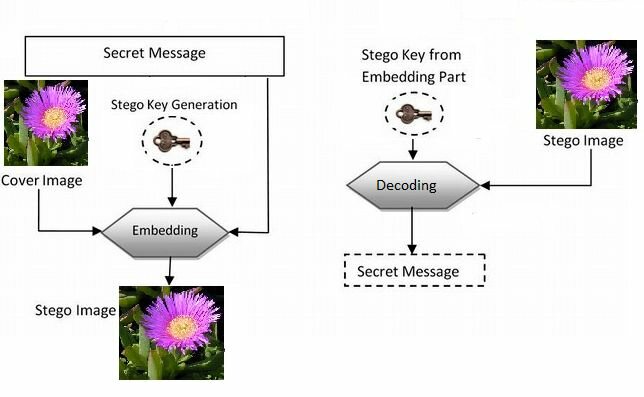
The word “steganography” comes from the Greek words STEGANOS (meaning “covered”) and GRAPHIE (meaning “writing”). Unlike cryptography, which scrambles data to make it unreadable, steganography’s primary goal is to hide the very existence of communication. The idea is simple yet powerful: if no one knows secret data exists, no one will try to extract it.
The LSB Technique Explained
Our research focused on the Least Significant Bit (LSB) method, one of the most fundamental approaches in image steganography. Here’s how it works:
The Core Concept
In an 8-bit grayscale image, each pixel is represented by 8 bits, giving us 256 possible intensity values (0-255). The beauty of the LSB technique lies in a simple observation: changing the least significant bit of a pixel only alters its value by ±1, which is virtually imperceptible to the human eye.
Practical Example
Let’s say we want to hide the letter ‘Z’ (ASCII: 10110101) in an image. We take the first 8 pixels of our cover image:
Original pixel values (binary):
1
2
3
4
5
6
7
8
01010010 (82)
01001010 (74)
10010111 (151)
11001100 (204)
11010101 (213)
01010111 (87)
00100110 (38)
01000011 (67)
After embedding ‘Z’ (10110101):
1
2
3
4
5
6
7
8
01010011 (83) ← LSB changed from 0 to 1
01001010 (74) ← LSB unchanged (already 0)
10010111 (151) ← LSB unchanged (already 1)
11001101 (205) ← LSB changed from 0 to 1
11010100 (212) ← LSB changed from 1 to 0
01010111 (87) ← LSB unchanged (already 1)
00100110 (38) ← LSB unchanged (already 0)
01000011 (67) ← LSB unchanged (already 1)
Notice that only 3 out of 8 pixels were modified, and by just 1 intensity level. This minimal change ensures the image appears identical to the naked eye.
Our Research Contribution
Key Features of Our Approach
Lossless Data Hiding: Our method preserves the visual quality of the cover image while maintaining the integrity of hidden data.
Spatial Domain Implementation: We implemented the LSB technique directly in the spatial domain, making it computationally efficient.
Enhanced Security: The embedded data remains undetected under normal viewing conditions, thanks to the masking capabilities of the Human Visual System.
High Embedding Capacity: The method can hide substantial amounts of data - theoretically, a text file the same size as the image.
Technical Implementation
Our system follows a straightforward workflow:
- Input: Cover image + Secret message + Password/Key
- Processing: LSB replacement in selected pixels
- Output: Stego-image (visually identical to original)
- Extraction: Reverse process using the same key
The encoding process uses a secret key to determine which pixels to modify, adding an extra layer of security. Without the correct key, extracting the hidden data becomes computationally infeasible.
Applications and Use Cases
Our research identified several practical applications:
- Military Communications: Hiding encrypted intelligence within routine image transmissions
- Digital Rights Management: Embedding copyright information in media files
- Secure Personal Communications: Private messaging in regions with internet censorship
- Data Integrity: Storing authentication keys within system files
Advantages and Limitations
Advantages
- Invisibility: Changes are imperceptible to human observers
- Simplicity: Straightforward implementation and low computational overhead
- Compatibility: Works with standard image formats
- Capacity: High data embedding potential
Limitations
- Vulnerability: Susceptible to steganalysis attacks
- Fragility: Sensitive to image compression and processing
- Detection: Statistical analysis can reveal LSB modifications
- Format Dependency: Limited to uncompressed or losslessly compressed images
Future Enhancements
Our research opens several avenues for improvement:
- Transform Domain Techniques: Moving beyond spatial domain to frequency domain methods for increased robustness
- Adaptive Embedding: Dynamic selection of embedding locations based on image characteristics
- Cryptographic Integration: Combining steganography with modern encryption for layered security
- Machine Learning: Leveraging deep learning for more sophisticated hiding strategies
Technical Implementation
The complete implementation of our research is available on GitHub, including:
- Source code for LSB embedding and extraction
- Sample images for testing
- Documentation and usage examples
- Performance benchmarks
🔗 GitHub Repository: steganography-using-8bit-LSB
Research Team
This project was a collaborative effort by a dedicated team from the Department of Computer Science & Engineering at Symbiosis Institute of Technology:
- Achintya Singh Baghela (Myself)
- Samarth Tyagi
- Devansh Desai
- Harsh Patel
Conclusion
Steganography represents a fascinating intersection of computer science, mathematics, and digital art. Our 8-bit LSB approach demonstrates that effective data hiding doesn’t always require complex algorithms - sometimes, the most elegant solutions are also the simplest.
As digital communication continues to evolve, the need for covert communication channels becomes increasingly relevant. Whether for privacy protection, digital rights management, or secure communications, steganography offers a unique approach to information security that complements traditional cryptographic methods.
The field continues to evolve with advances in machine learning and computer vision, presenting both new opportunities and challenges. As detection methods become more sophisticated, so too must our hiding techniques - ensuring that the ancient art of secret communication remains relevant in our digital age.
This research was conducted as part of my final year project at Symbiosis Institute of Technology (Nov, 2022). The full research paper and implementation details are available for academic and educational purposes.